How Superhuman Rebuilt Dunning, the Most Under-Loved Journey in Lifecycle
A teardown of the dunning rebuild that reshaped the renewal program of Superhuman (formerly Grammarly), told by Oleksii Choban, who owns post-conversion touchpoints.
By Drew Price and Scott Christensen, with Oleksii Choban, renewals and post-conversion lifecycle at Superhuman. Published with JRNY PPL.

Oleksii Choban leads renewals and post-conversion lifecycle marketing at Superhuman (formerly Grammarly). His work has spanned Braze, Iterable, Customer.io, and Klaviyo across a career focused on retention, renewals, and cross-functional experimentation.
After he was hired, Oleksii and his team ran 15 experiments against one particular journey they inherited. The one they had the least love for. The one most lifecycle teams in the industry never touch.
This is a teardown of one of those programs: the dunning journey, which Oleksii and his team rebuilt over seven months of testing across channels, design, and timing.
The Background
Every subscription business loses money to failed payments. Cards expire. Banks issue soft declines. Debit cards get frozen. Something goes wrong on the payment processor's side. The customer never explicitly cancels. They just fall off the roster because the charge didn't go through.
The industry has a name for the program that recovers those customers: dunning. Oleksii put it plainly in our interview:
“Dunning is the most under-loved process and program in lifecycle.”
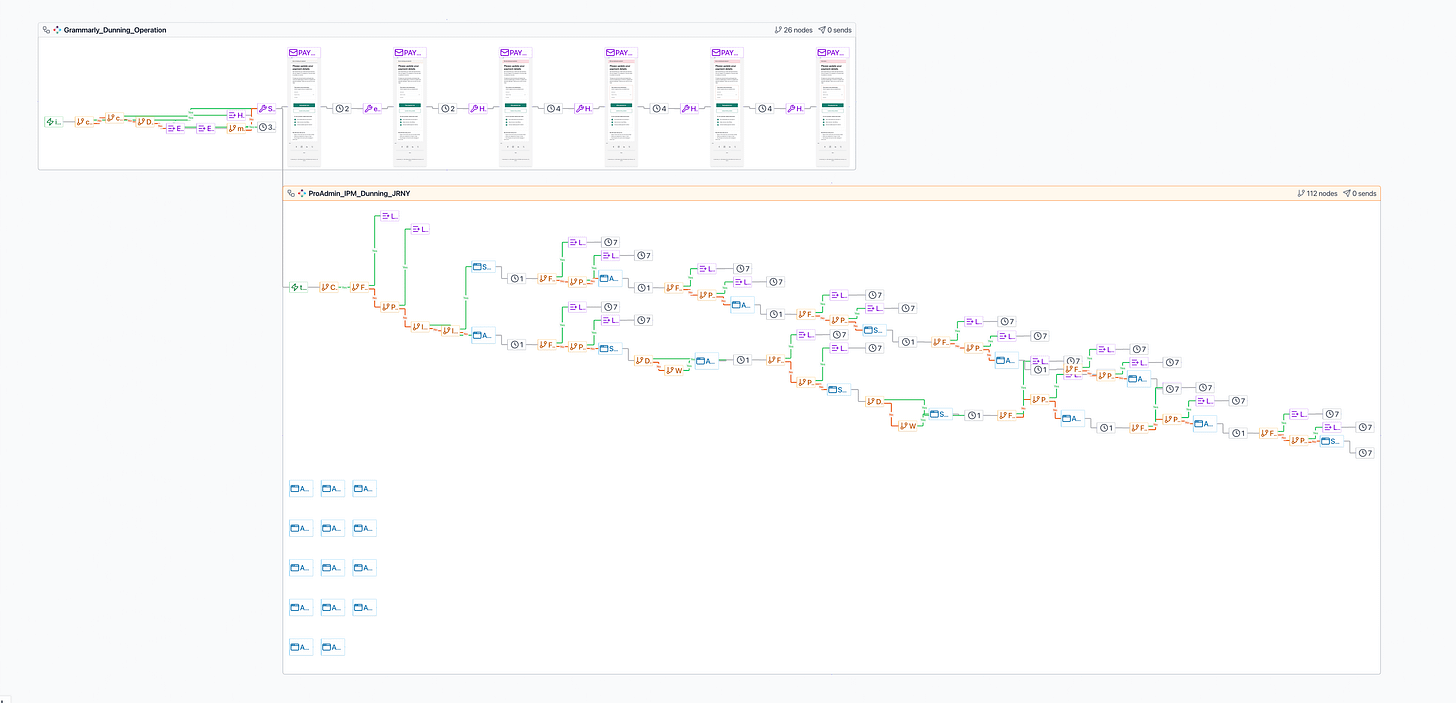
At Superhuman, that was literally true. When Oleksii joined the renewal team, the dunning journey had exactly two touch points across a four-week window. One email at the start of the dunning period, one near the end. Both were written in the same warm, on-brand voice the rest of the marketing program used. "Your payment failed. Nothing to worry about. Check your payment details."
They didn't say what failed. They didn't say why. They didn't say which of the customer's saved cards was the one that got declined. They didn't say what would happen if the customer didn't act. They were transactional emails written like marketing emails, and the recovery numbers reflected it.
Oleksii had a chunk of otherwise-loyal users churning passively every month, entirely because the recovery communication wasn't communicating.
The Hypothesis
Oleksii and the team scored a stack of hypotheses across three pillars:
- Number of touch points. Two emails across four weeks wasn't enough to catch users at the moment they were most likely to act.
- Channels. Email was the only recovery surface. In-product notifications, which reached the user while they were using Superhuman, weren't being used at all.
- Design. The emails looked and read like marketing. They needed to shift toward transactional clarity: what failed, what to do, what happens if you don't.
The team ranked hypotheses by effort and expected impact, and started with the lowest-effort tests to build momentum. Every rebuild was a real A/B against the existing two-email control.
The Flow
Four rebuilds drove the compounding gains.
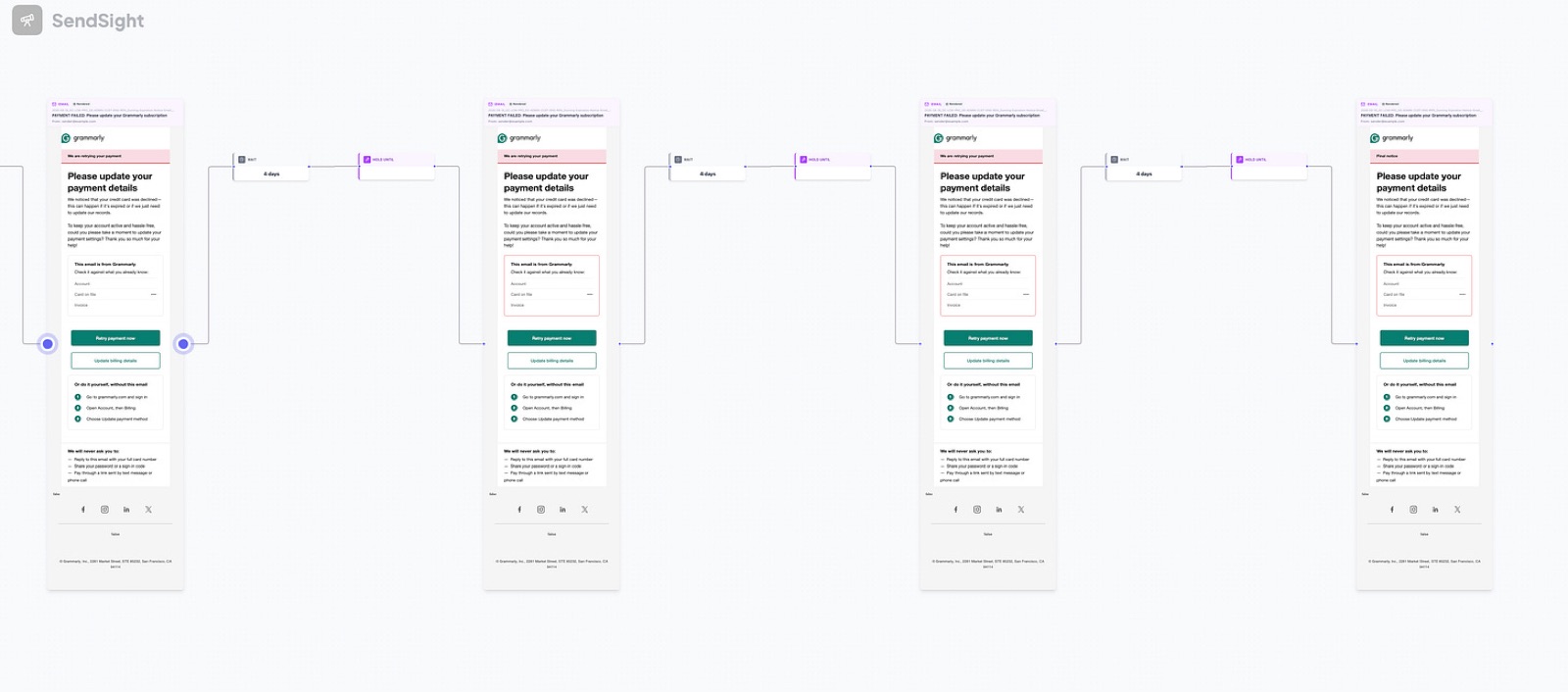
Rebuild 1: More touch points. The team added four additional email touch points across the four-week dunning window, keeping the original copy and design. This alone lifted dunning recovery, the north-star metric they'd introduced to track how many payment-failed users successfully paid and continued their subscription.
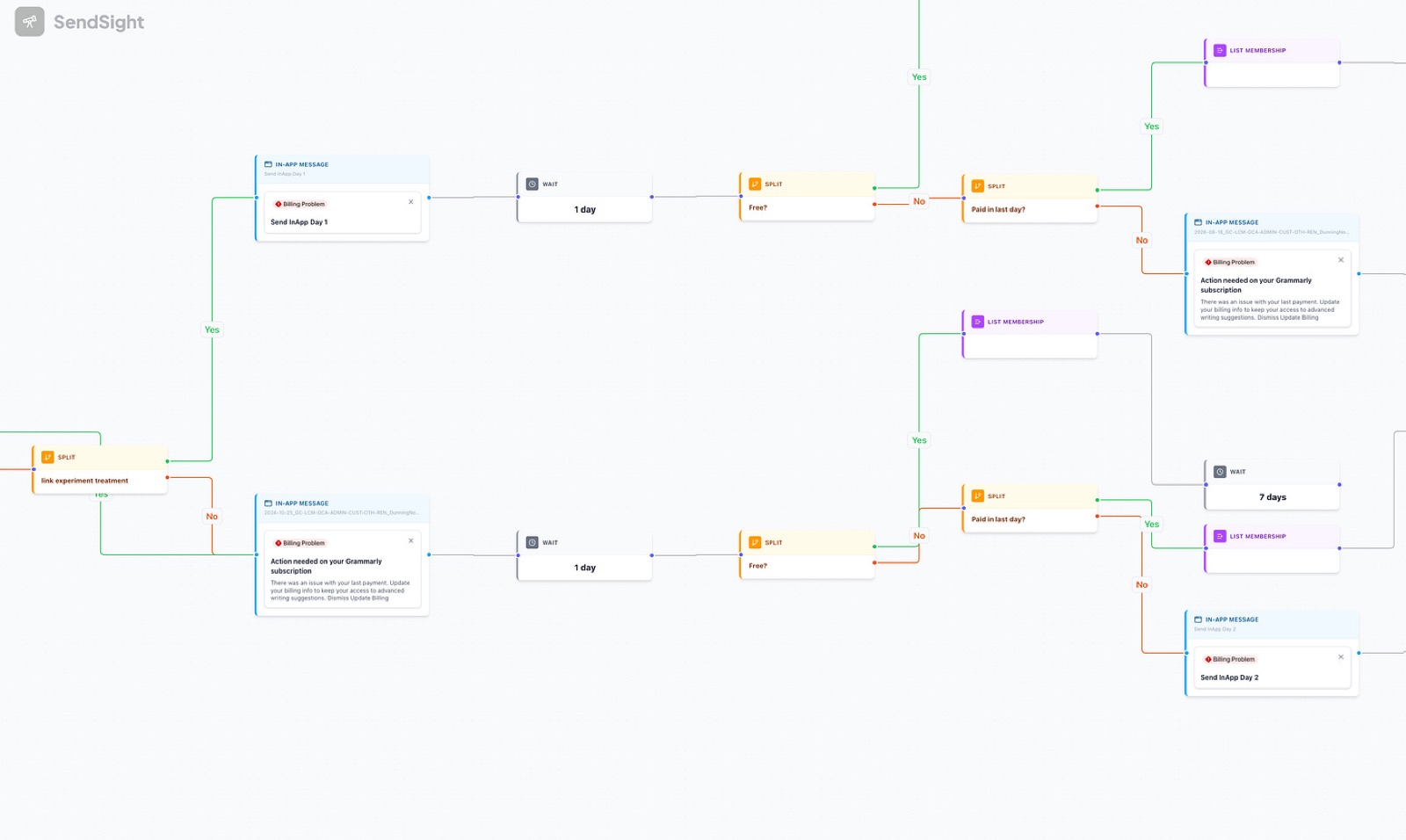
Rebuild 2: A new channel. During the seven-day paid grace period, when users still had full access to Superhuman, the team added in-product popup notifications at the bottom of the screen. Less intrusive than a takeover banner, but visible whenever the user opened the product. This channel alone drove roughly 50% of total dunning recovery.
Rebuild 3: A transactional redesign. The team rewrote the emails from marketing voice to transactional voice, and added a section that displayed the customer's payment details securely, working in close partnership with Legal to ensure appropriate payment metadata was surfaced. The result: users could see at a glance which card had failed, which processor issued it, and what the last four digits were.
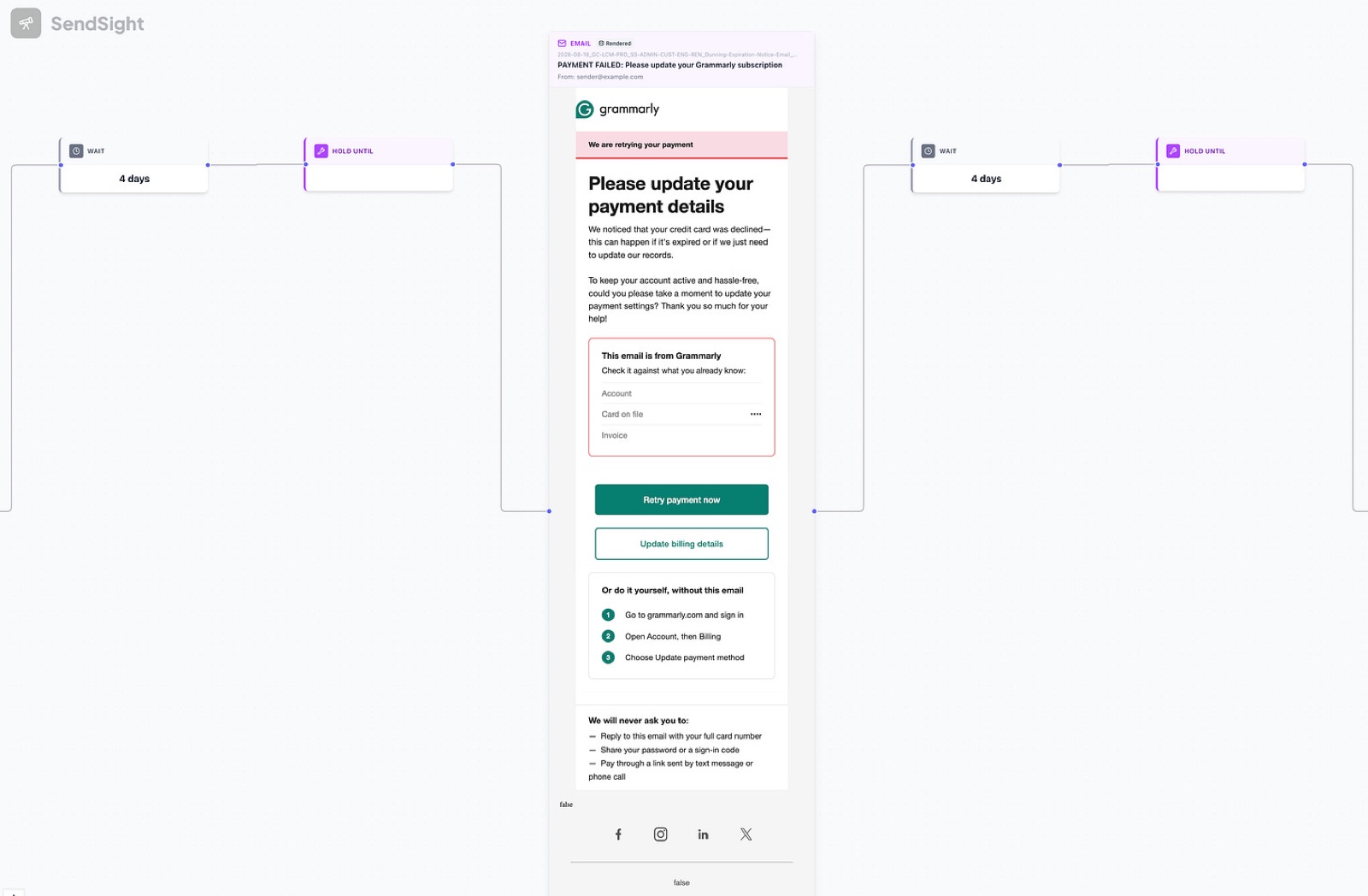
Rebuild 4: Timed to the backend. This was the smartest test in the series. Superhuman's payments engineering team had built a "smart retry" system on the backend that already knew when the next attempted charge would be most likely to succeed. Oleksii asked the obvious question nobody had asked: why don't we send the recovery emails at those same moments? He connected his lifecycle triggers to the smart retry system's schedule. It's "smart" because a failed charge isn't one thing; a card that bounced for insufficient funds behaves very differently from one the issuer held, so the backend predicts a per-customer moment when the retry is most likely to clear instead of firing on a fixed calendar. Emails now landed at the specific times when the backend expected the user's payment to work.
Three of these four experiments were significant wins. The team ran 15 experiments in total across November through May.
Lessons Learned from Losses
Loss 1: Who the messages annoy. The largest block of experiments went to a question that's easy to state and slow to answer: which users do these notifications actually help, and which ones are just being bothered? The team cut the population by plan type, by what people were doing in the product, by the payment details on file, and by the type of error behind the failure, then looked at how each slice responded to being contacted. Some slices were fine. For others, the notification wasn't persuading anyone of anything. It was landing on someone with no problem to solve, or no intention of solving it, and reminding them a subscription existed.
Loss 2: Trial converters. The biggest drawback in the series. When the first charge after a trial failed and the user got the standard dunning sequence, they canceled outright at a noticeably higher rate. The channel-shift reading that explains the proactive-cancellation result doesn't hold here: those were established payers moving from silent lapse to explicit cancellation. Trial users hadn't established anything. They were still deciding, and a dunning email doesn't address someone who's deciding; it addresses a customer with a broken card. That wasn't a role they'd taken on yet, so instead of prompting a card update, the message prompted a fresh look at whether they wanted the product at all.
The Result
~50%
of the recovery lift came from in-product notifications
15
experiments run, November through May
+60%
proactive cancellations, and net paid rate still rose
Dunning recovery went up meaningfully across every rebuild. The in-product notifications alone drove roughly 50% of the total lift. The transactional redesign and the smart-retry timing added compounding gains on top.
But the more interesting result is the one that scared stakeholders at first. Notifying users about their failed payment lifted proactive cancellation rate by as much as 60%. Reminding a paying customer that they're paying triggers a reassessment, and some percentage of them decide to cancel outright rather than fix the card.
Oleksii's read: this isn't a loss. It's a channel shift. Those users were moving from passive churn (where they would have silently rolled off at the end of the dunning period) to active churn (where they explicitly canceled). The net paid rate at the end of the dunning process still rose, because the recovered users outweighed the ones who used the reminder to leave.
The takeaway matters beyond dunning: any recovery program that surfaces a payment option will re-open the customer's evaluation of whether they still want the product.
Takeaways
A few things other lifecycle operators can steal from this rebuild:
- 1Dunning is the highest-leverage neglected journey you own. Most lifecycle teams pour attention into onboarding, activation, and re-engagement while treating failed payments as an ops problem. It isn't. It's a lifecycle problem with real revenue on the other side. Audit yours.
- 2Score your hypothesis stack cross-functionally, not solo. Oleksii's biggest career mistake, in his own words, was scoring hypotheses alone. Bring the designer, the PM, and the data scientist into the ranking session. The people outside lifecycle ask the questions you can't see.
- 3Coordinate lifecycle triggers with backend systems that already know things. If your payments team has built retry logic, timing logic, or fraud logic, that logic is a lifecycle signal. Connect to it. Don't rebuild the same intelligence one layer up.
- 4Distinguish transactional voice from marketing voice. A payment-failed email in warm brand voice is confusing. Users can't tell what's routine and what's urgent. Rewriting the flow as pure transactional communication, with clarity about what failed and what to do, moved the needle on its own.
- 5Track net paid rate, not intermediate cancellation. Recovery programs that surface subscription decisions will lift proactive cancellation. That's not the metric to optimize. The metric is what percentage of the cohort is still paying at the end of the process.
Drew's Operator POV
Lifecycle teams love talking about the top of the funnel. Welcome series. Reactivation. The "we broke through" one-off campaigns. Nobody loves talking about dunning.
Which is precisely why dunning is where the money is.
Oleksii's rebuild is a case study in the unglamorous work that actually shifts LTV. He found a program nobody wanted to own, ran fifteen experiments against it, and stitched it into a piece of backend infrastructure most lifecycle marketers don't know exists. The result is a program that recovered users the industry had accepted as an inevitable cost of running a subscription business.
The lesson I want operators to take home: the journey with the biggest ceiling left in your program is probably the one nobody wants their name on. Take it.
-Drew
About the practitioner
Oleksii Choban leads lifecycle marketing at the AI-powered writing and productivity platform Superhuman. His lifecycle work has spanned Braze, Iterable, Customer.io, and Klaviyo across a career focused on retention, renewals, and cross-functional experimentation.
Oleksii credits the cross-functional partners who drove the dunning rebuild alongside him: Dmytro Stepovyi, Oleksii Zghurskyi, Julie Long, Christina Dillingham, Gerard Paul Leyson, and Yurii Shevchuk.
The journey snapshots in this teardown come from the team's live program, mapped in SendSight. Want your journey taken apart next? Apply to be featured.
Get the next teardown
One real journey a month, taken apart with the person who built it. No digest, no product updates in between.
Prefer Substack? Read it there or follow JRNY PPL.