How Mercury Rebuilt Its Welcome Series Around the Customer, Not the Org Chart
A teardown of Mercury's welcome series rebuild, walked through by Ellen Rockdale, who leads lifecycle at Mercury.
By Drew Price and Scott Christensen, with Ellen Rockdale, lifecycle at Mercury. Published with JRNY PPL.
Ellen Rockdale has spent her career building lifecycle programs at companies like Lyft, Block, Care.com, and HoneyBook. When she joined Mercury in April 2025 as the company's first lifecycle hire, she inherited a welcome series that had accumulated years of well-intentioned additions but lacked a cohesive strategy.
A year later, she and her newly-hired team of five have launched new behavioral nurtures, rebuilt the key onboarding flows, and stress-tested programs that hadn't been touched in years.
This is a teardown of one of those programs: the welcome series, which Ellen and her team rebuilt and launched in late January 2026.
The Background
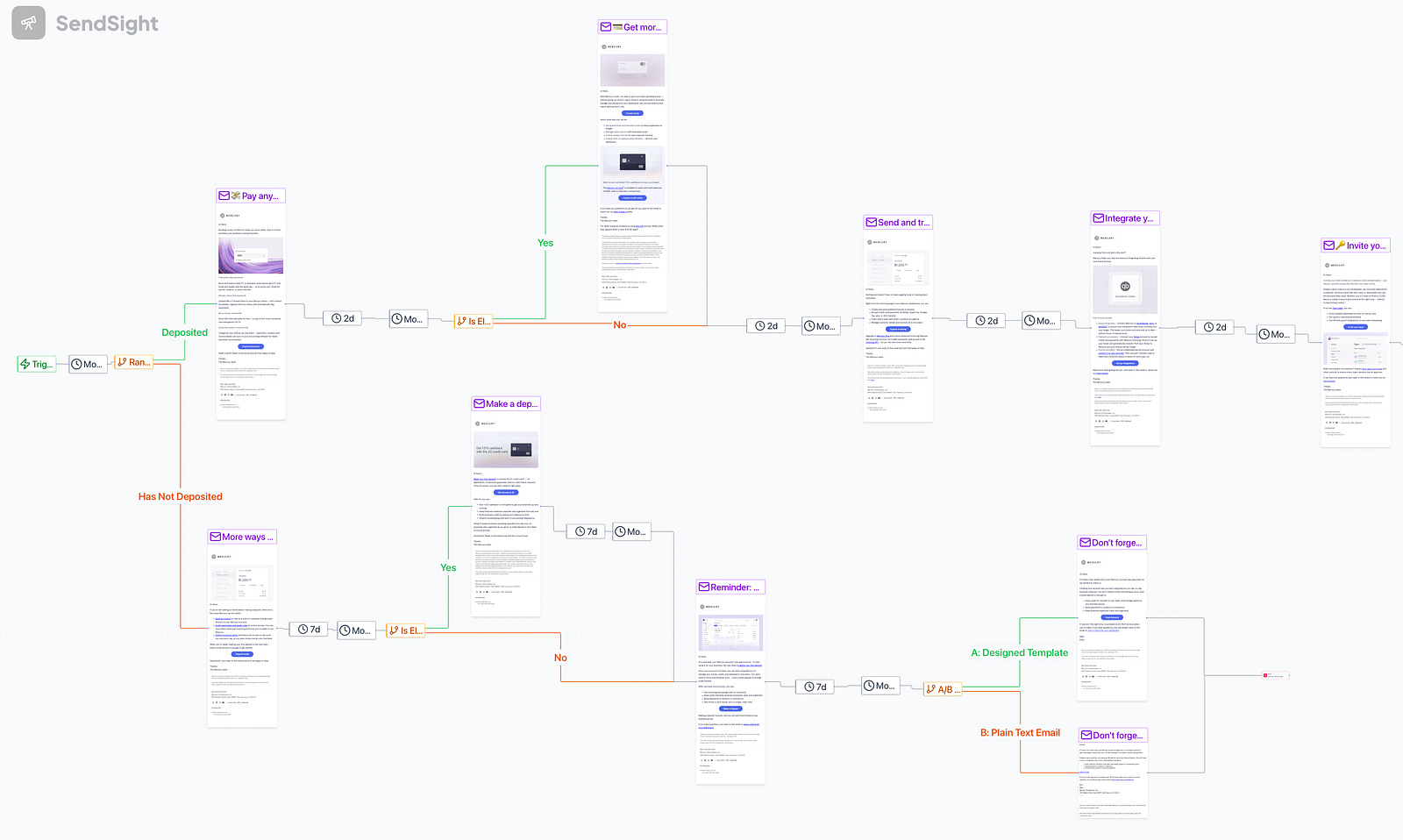
The welcome series was running, but it had been on autopilot for years. Maintained by an email ops person and a rotating cast of product marketers who advocated for their own features. The Cards product needed a moment. Invoicing wanted a slot. Treasury was important. The program grew to accommodate them, one email per product line, sent on a clock.
Ellen phrased it well when she said:
“By default, teams tend to design their lifecycle program to the shape of their organization.”
When taking more critical eye on the flow, she and her team noticed a portion of Mercury's newly-approved business banking customers* were not, in fact, ready for deep product education. They hadn't funded their accounts yet.
The program was treating "time elapsed since approval" as a proxy for "ready for this content." It was wrong.
The Hypothesis
Ellen and her team's hypothesis was simple: funded and unfunded users need different messaging.
For users who hadn't funded yet, the content of the welcome series should not be a feature tour. It should be motivation. It should answer "why should I fund my account?" before it ever answers "how do I use Mercury's treasury product?" The deposit needs to feel like the obvious next step.
So the team built a separate track. Non-depositors got routed into a new flow. Anyone who funded along the way exited immediately. Targeting was tight: primary owners of business accounts, post-approval, with no deposit yet.
They tested it against the existing welcome series with an A/B test. The control had seven emails. The new variant had four. Nearly half as many.
The Flow
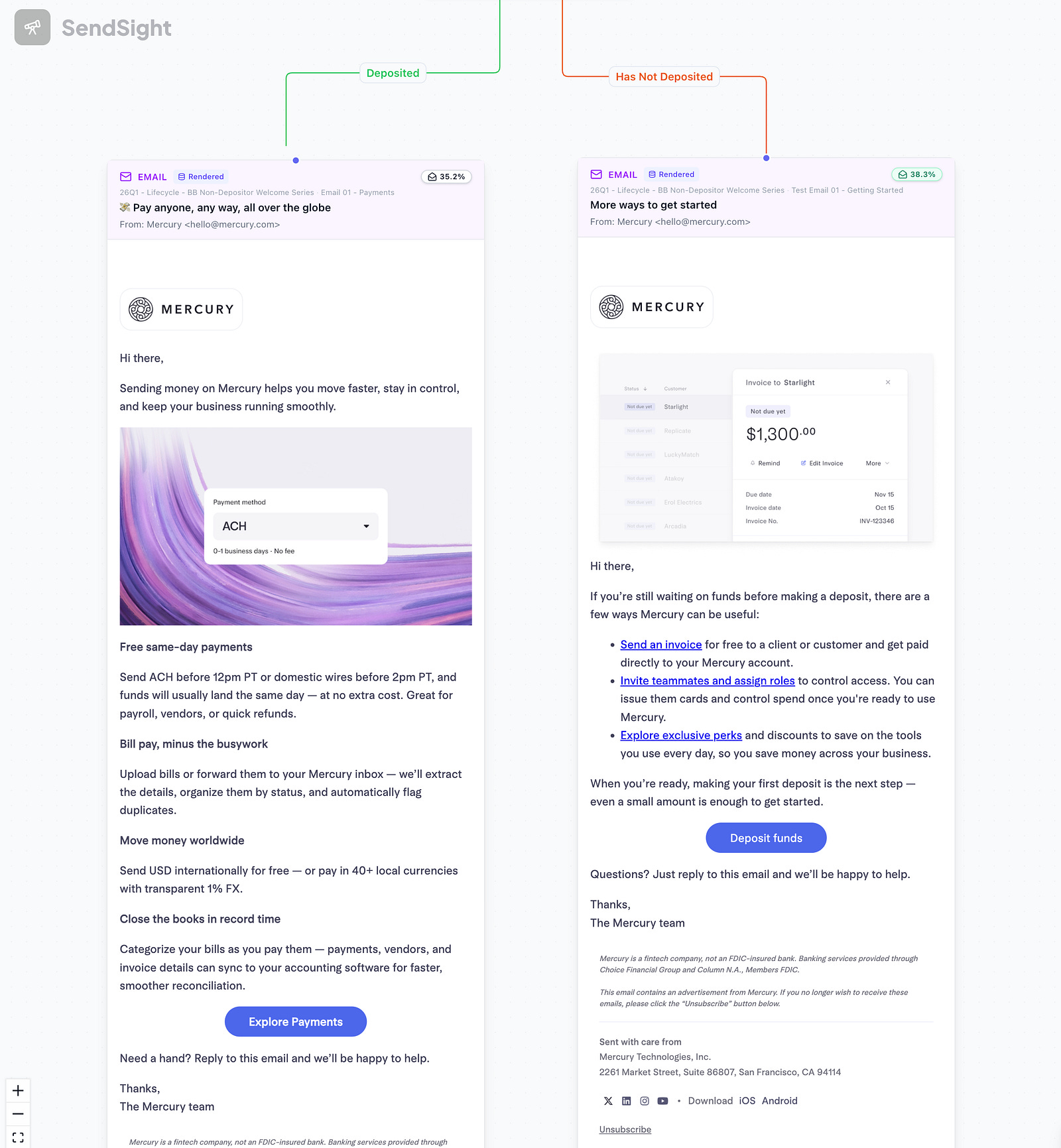
The initial split educated non-depositors of other ways to get started. Send an invoice. Invite teammates. Explore perks. The primary CTA, "Deposit funds," says we know you're not ready yet, and that's okay.
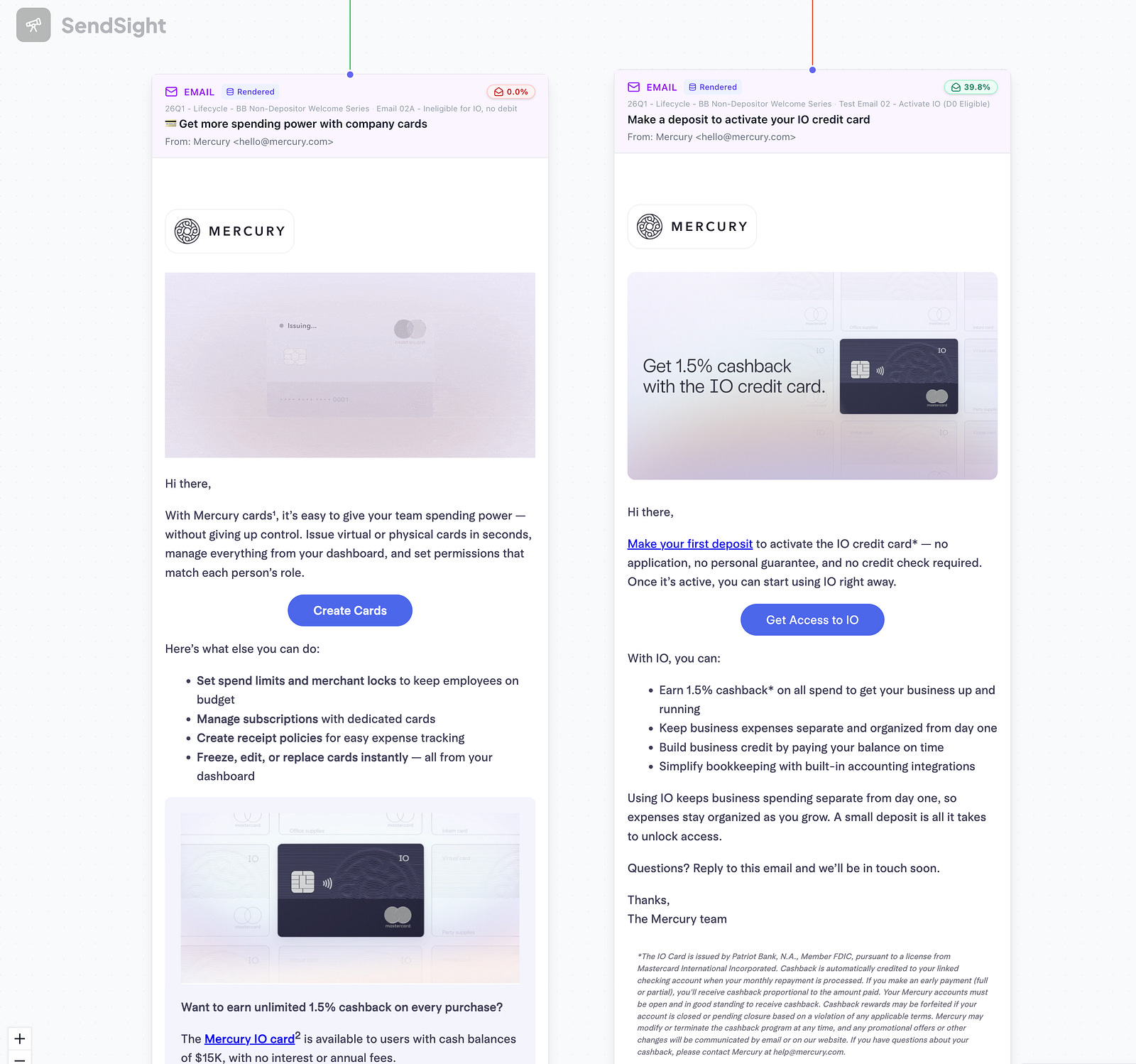
Another key moment in the split journey was leveraging pre-qualification for the Mercury IO credit card.**
For users already eligible for the card, the team used the 1.5% cashback incentive to motivate a first deposit. Notably, the CTA isn't "Deposit funds" but "Get Access to IO." The deposit becomes the means to an end, with the card positioned as the reward.
The flow closes with a final reminder, and inside it lives the most counterintuitive test in the rebuild.
The team tested a plain-text email that looked like it came directly from Ellen against the designed, branded reminder. Plain-text usually wins this kind of test. It feels personal. It breaks through.
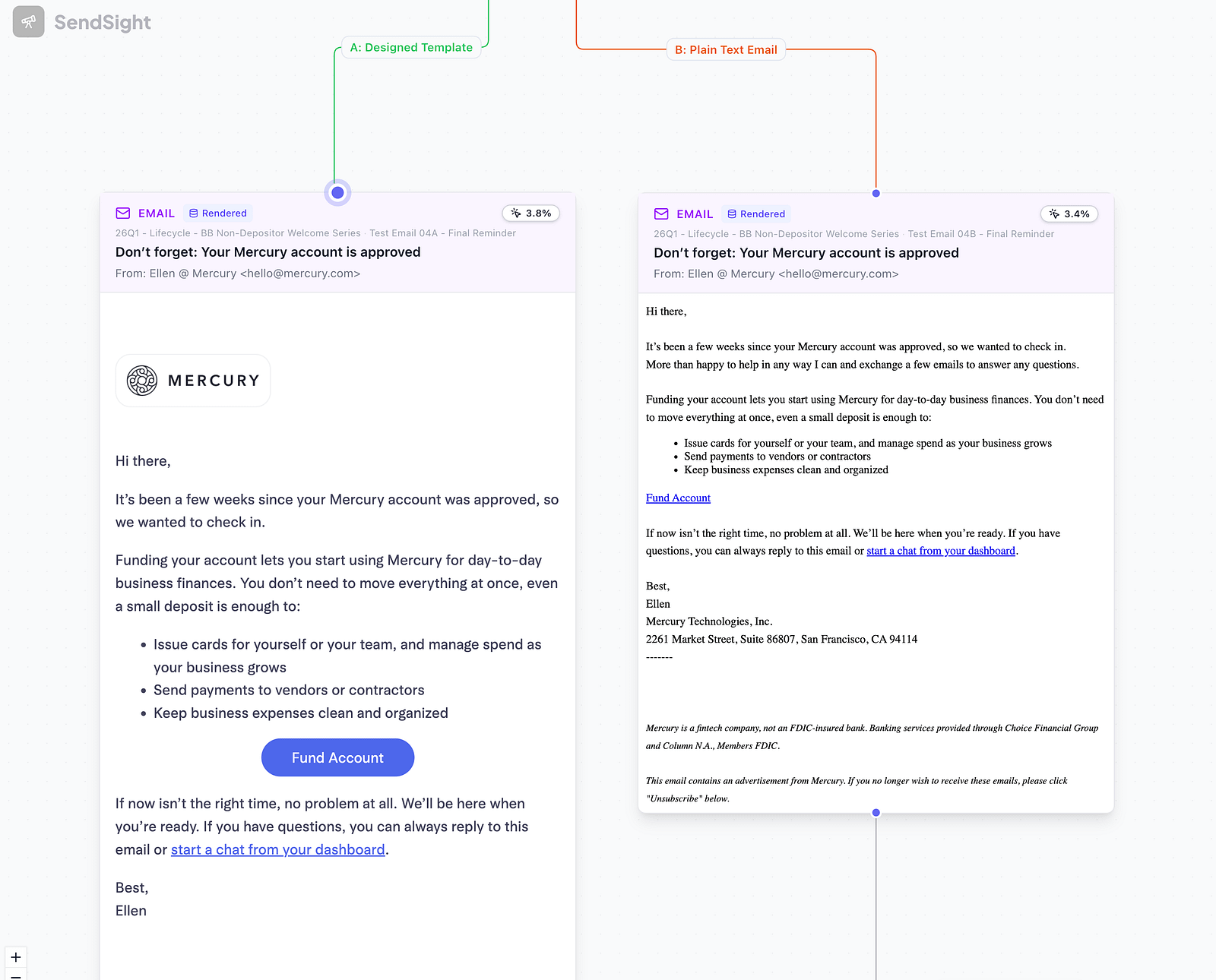
However, this time, the designed email won.
Ellen's read on why: low-intent users at the tail of a welcome series aren't shopping for a relationship manager. They aren't in active evaluation mode. They're not looking for a person at Mercury to talk to. The branded reminder fit the audience better than the faux-personal one.
The Result
+10%
first deposit rate
+70%
click-through rate
-50%
unsubscribes
4 of 7
emails kept
First deposit rate went up 10%. Opens were up 10%. Click-through rate up 70%. Unsubscribes down 50%.
Every metric the team tracked moved the right way. Half as many emails outperformed the legacy program on every line of the scorecard.
The new flow stopped talking past the audience. It spoke to people where they actually were in the journey, not where the calendar said they were supposed to be. And it stopped trying to introduce seven product features to people who hadn't used any of them yet.
Takeaways
A few things other lifecycle operators can steal from this rebuild:
- 1Audit your welcome series for the org-chart problem. If each email maps to a product line and each product line maps to a PMM, the series was probably designed by the shape of your internal teams, not the shape of your customer journey. Reshape it around what the user is actually doing.
- 2Don't be afraid of the sacred cows. Legacy programs that have been running unchanged for years are usually the ones with the most ceiling left. They survived because nobody dared to question them. Question them.
- 3Test by behavioral state, not just time elapsed. Day 7 means nothing if half your audience hasn't taken the action that makes the next email relevant. Branch on state.
- 4Less can be more, when content is tailored. More emails is a strategy that works when each email earns its keep. If they're filler, they're hurting you.
- 5Plain-text isn't a universal win. It's a tool for high-intent audiences in active evaluation. For passive, low-intent cohorts at the tail of a welcome series, a branded reminder can outperform a faux-personal email.
Drew's Operator POV
I read a lot of lifecycle case studies. Most of them are dressed-up retros that bury the real lesson under a thicket of acronyms. This one isn't.
Ellen and the Mercury team are doing something important. They're auditing their own program for the org-chart problem, which is one of the most common failure modes in lifecycle marketing and almost nobody is looking for it.
If your welcome series can be described email-by-email because that's how your PMM team is sliced, you're shipping your org chart to your customers. They didn't ask for it. They probably can't tell that's what you're doing. But the program isn't built for them. It's built for you.
-Drew
*Mercury is a fintech company, not an FDIC-insured bank. Banking services provided through Choice Financial Group and Column N.A., Members FDIC.
**The IO Card is issued by Patriot Bank, N.A., Member FDIC, pursuant to a license from Mastercard International Incorporated. Eligible customers can access the IO card on day one of opening a Mercury account, limitations apply. To receive cash back, your Mercury accounts must be open and in good standing, meaning they cannot be suspended, restricted, past due, or otherwise in default.
About the practitioner
Ellen Rockdale leads lifecycle marketing at Mercury, the fintech more than 300K ambitious companies trust with their finances. The lifecycle team focuses on turning complex customer behavior into actionable, scalable marketing programs.
Ellen credits teammates Alexa Martinez, who drove much of the content strategy for the new flow, and Anya Vo, who helped shape the test design and the eligibility branching.
The journey snapshots in this teardown come from the team's live program, mapped in SendSight. Want your journey taken apart next? Apply to be featured.
Get the next teardown
One real journey a month, taken apart with the person who built it. No digest, no product updates in between.
Prefer Substack? Read it there or follow JRNY PPL.